

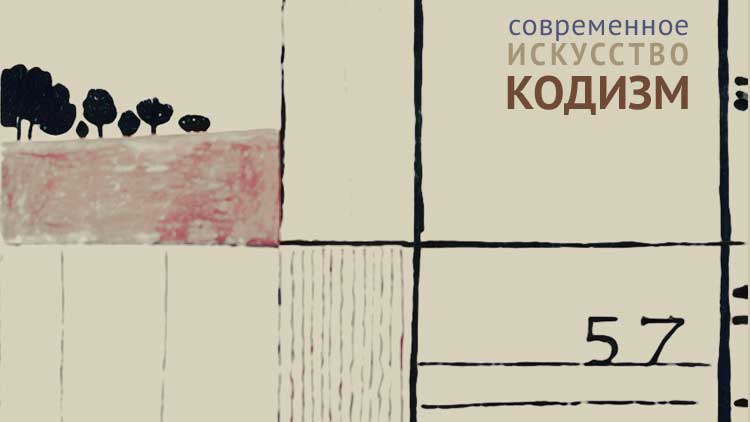
This study establishes the philosophical and artistic paradigm of a new contemporary art movement — Codism.
At the core of Codism lies the idea of seeking and selecting the deep harmonic codes of reality, semantic codes, and the artistic modeling of integral images as a form of metaphysical cognition of the world.
Introduction
Contemporary culture is experiencing an era of unprecedented visual overproduction. The modern subject lives in a space of continuous visual flow. Images have lost their depth and have become superficial stimuli.
Contemporary art is developing under conditions of radical transformation of the cultural space. Information overload, the multiplicity of visual languages, and the acceleration of communication lead to fragmentation of perception and the erosion of stable artistic and aesthetic criteria.
On the one hand, humans are immersed in an endless stream of images; on the other, these images increasingly lose their depth and internal coherence.
In conditions of information overload and a multitude of disparate visual and semantic flows, the true value lies not in the production of new visual variants, but in the ability to select, interpret, and model the most expressive artistic images, meaningful semantic elements, and harmonic structures.
Codism is an artistic movement based on the search, selection, and interpretation of the deep harmonic codes of reality and semantic codes, their organic combination, and the modeling of powerful, integral, and metaphysically saturated artistic images.
Codism emerges as a response to the disintegration of perceptual integrity (the fragmentation of perception), the oversaturation of the visual environment, and the crisis of aesthetic categories. Its task is to restore depth, integrity, and the metaphysical function to art. The metaphysical function consists of restoring the connection between humans and the integral order of being through the act of aesthetic choice.
Codism proposes to view art as a process of discovering, selecting, and connecting harmonic and semantic codes that form an integral artistic image. It unites philosophy, analysis, artistic design, and the modeling of visual images and spaces into a single creative method.
Codism arises as a response to the crisis of contemporary perception, the fragmentation of experience, and the loss of integrity in art. It proposes a shift in emphasis:
-
from accumulation — to selection
-
from quantity — to quality
-
from surface effect — to depth
In human history, a period begins in which the selection of information and the filtering of proposed interpretations and images become paramount. What becomes important is not the emergence of new stylistic variants or techniques in art, but the development of tools and methods for selecting the most interesting and expressive ideas and images.
Foundations of Codism
Brief formula:
Gaze — Search — Selection — Modeling
The concept of Codism is based on the search, selection, and interpretation of deep harmonic codes, and on the modeling of powerful artistic images and expressive visual spaces founded upon the artist's philosophical understanding of the world.
Art in Codism is the highest form of programming and creation available to humans. The artist operates with harmonic and semantic codes, ideas, archetypes, and information.
The artist's task is to create an integral, fully assembled "code" (the artwork), which, when activated in the viewer's consciousness, reconfigures their perception, opening access to deeper layers of reality.
Art performs the function of seeking and creating harmony as an element of deep reality, reflecting a new picture of the world. It affirms the principles and forms of an alternative vision of the world, its explanation, and understanding. Aesthetic experience is regarded as a form of metaphysical recognition.
Raising the question of the value of art in the context of Western and Eastern philosophy, an important formulation can be proposed: the task of art is not to reflect the visible, but to reveal (make visible) the invisible.
Art helps to embody in artistic images a picture of the deeper layers of reality, its most important structures and concepts, through the prism of the artist's personal vision of the most crucial worldview and philosophical categories.
Codism proceeds from the idea that any form of reality — material and immaterial — contains within itself certain harmonic codes: forms, rhythms, proportions, combinations, energetic relationships, symbolic structures, semantic tensions, etc.
The artist's task consists not of copying the external world, but of:
-
discovering these codes
-
selecting them
-
interpreting them
-
artistically recreating the actual world — modeling an artistic whole as a part of the single whole underlying reality
The artwork becomes a concentrate of harmony and meaning — a space where multiple discovered codes unite into an integral image and amplify each other.
Philosophical Foundations
In the concept of Codism, humans are regarded as bearers of an innate capacity for the perception of harmony and integrity. This capacity cannot be reduced to empirical experience or cultural conditioning; it has a deeper nature.
Human consciousness contains within itself a "reflection of the Absolute," and aesthetic feeling is a form of metaphysical memory of the Whole that lies at the foundation of being.
In aesthetic experience, a person does not merely perceive form — they recall their connection to the source of being; it becomes a form of metaphysical recognition.
Therefore, humans are capable not only of perceiving beauty but also of recognizing the deep order of the world. Harmony is felt as a coincidence of inner and outer, as a return to integrity, as an experience of the unity of the human being and the Whole of existence. Not the part, but the whole — that is the metaphysical basis for the feeling of unity and internal coherence of being.
In humans, something greater than the ability to perceive forms, colors, and sounds is originally embedded. They harbor a secret knowledge of the order of being — an inner attunement to the wholeness of the world. Therefore, the beautiful is never merely an external impression: it is experienced as recognition, as a quiet coincidence of inner and outer, as a return to a lost but not forgotten fullness.
This position is consonant with Plotinus's idea that the soul is capable of recognizing beauty because it participates in the One. Similarly, in the philosophy of Immanuel Kant, harmony is understood as the result of the coordination of cognitive faculties, which indicates a structural proportionality between humans and the world.
In its ontological aspect, Codism asserts that reality is not static but represents a continuous process of the "manifestation of the unmanifest." Art in such a paradigm does not imitate external reality but participates in the very act of becoming, turning to its archetypes. The artwork becomes an event in which the invisible takes form and the potential becomes actualized. Thus, art is incorporated into the very process of being.
Artistic creation is the objectification of the subject, the manifestation of the unmanifest for the viewer. This is the deep function of art: not to reflect the visible, but to reveal the invisible.
The artist does not copy the external world but approaches the archetypes, the ideal reality from which things originate. Art is not imitation of nature but an ascent to its metaphysical source. The artist intuitively grasps the harmony of the One and embodies it in an image.
Art becomes a way of manifesting the invisible — a form of metaphysical revelation. In the depths of the human being, there is a connection to the source of being — whether called God, the Absolute, or the Whole. And every time a person stands in awe before the beautiful, for a moment, they return home.
Core Principles and Methodology of Codism
Codism is based on the following principles:
-
Humans contain within themselves a reflection of the Absolute and are capable of perceiving harmony as a form of connection with it.
-
Aesthetic feeling is a manifestation of metaphysical memory of the wholeness of being.
-
Art is directed not at imitating nature but at ascending to its archetypes.
-
The artistic image is a form of manifesting invisible reality.
-
Harmony is perceived as a resonance between the inner world of humans and the structure of being.
-
The artist acts as a mediator between the visible world and the deep order of existence.
The methodology of Codism is built on several fundamental capacities of the contemporary artist:
-
The capacity to create new concepts, generate ideas, values, and to find meanings in objects and phenomena that differ from those of others.
-
The search for deep, powerful harmonic codes in the surrounding world and in the imagination — the ability to notice, highlight, and select them is one of the key skills required of the contemporary artist.
-
Choice and selection. Art is about choice — constant, complex, necessary. The artist is defined by choice.
-
Selection of harmonic codes: In an era of information overload, selection becomes the key skill. The artist seeks in the surrounding world and in the space of imagination the most powerful "codes" — visual and semantic structures that resonate with the inner order of being. This requires: a special gaze upon the world, objects, and phenomena; visual literacy in the field of art; and aesthetic intelligence.
-
Artistic modeling: The creative process is understood as the construction of "spaces of meaning." This is not merely recording a moment, but creating a new integrity where the selected codes are synthesized into a unified image possessing a high concentration of intellectual and emotional energy.
Holistic principles become important — where the whole has significantly greater expressive, aesthetic, and intellectual value, and a stronger emotional impact. Modeling is the creative creation of a whole that expresses the final image and idea, absorbing a set of discovered important harmonic codes, as well as the emotional and intellectual engagement of the author.
At the center of the movement is the human being as a bearer of the metaphysical capacity to perceive integrity, order, and connection with the Absolute. Harmony is understood not as decorative beauty, but as an experience of the ontological unity of the world.
Codes
Codism proposes to view the artwork by analogy with literary and musical expression — as a structured system possessing its own grammar, syntax, and semantics.
In this paradigm, art ceases to be merely visual form and reveals itself as a language — a special way of organizing and transmitting meaning through harmony.
At the basis of this approach lies the idea that the primary elements of artistic thinking are not images or stylistic devices, but harmonic codes — fundamental structures of reality that manifest themselves in rhythms, proportions, color relationships, forms, symbolic connections, and other elements/phenomena.
By a basic code is understood the minimal unit of harmony and meaning, possessing independent expressive power. The artwork in Codism is considered as a system of harmonic and semantic codes.
Harmonic codes in Codism perform a function analogous to words in language or sounds in music. They are minimal units that already contain a certain meaning and expressive energy.
However, unlike linguistic signs, a code is not conventional. It does not merely denote — it directly embodies the structure of reality. In this sense, the artistic language of Codism is closer to music than to verbal speech: it operates not through designation, but through resonance.
Each artist forms their own "lexicon" — an individual set of codes developed through experience, intuition, and interaction with cultural tradition. This lexicon becomes the basis of their artistic language.
Individual codes rarely exist in isolation. They unite into stable combinations — harmonic blocks, which can be seen as "phrases" or "sentences" of the visual language.
A harmonic block is a configuration of codes linked by internal meaning and possessing a recognizable expressive function. It is at the level of blocks that the artist's individual signature emerges.
Each artist develops their own library of codes and their own unique set of harmonic blocks — stable, recognizable combinations of codes. This is their personal vocabulary, their artistic handwriting.
These blocks are not mechanical combinations. They form as a result of selection and become fixed in practice, becoming bearers of specific semantic and emotional states.
Just as words are combined into sentences according to the laws of grammar, harmonic blocks are combined into a work according to the laws of artistic syntax. These are the laws of contrast and nuance, rhythm and pause, dominance and subordination, development and climax, and so on.
An individual image or semantic fragment can be seen as a "sentence" expressing a complete thought. The artwork in this system appears as a "text" possessing internal logic, structure, and directionality — as a means of expressing thoughts and feelings, characterized by a harmonic-aesthetic foundation and artistic-semantic completeness (integrity).
The artwork, within this approach, is evaluated not so much by technical skill or novelty, but by its artistic and semantic completeness. It must be syntactically "literate": the idea must be clearly and fully expressed in the language of harmonic blocks. Beauty here is identical to the integrity and meaningfulness of the utterance. Incompleteness or internal contradictions are regarded as a syntactic error that disrupts the clarity of the metaphysical message.
If syntax determines structure, then semantics is concerned with meaning. In Codism, meaning is not given in advance nor definitively fixed — it arises in the process of interaction between the work and the viewer.
The artwork does not contain a fully "finished" meaning, but initiates the process of its emergence. It does not transmit ready-made content, but organizes a field of possible meanings. The artist forms a structure in which meaning can manifest, but does not impose it.
Meaning can be defined as an answer to a question, but the question is primary here. The work structures the field of possible questions, thereby directing interpretation.
Thus, art becomes a form of knowing the world through its primordial harmony and of communicating that harmony to the viewer.
Artistic Modeling
The process of creating a work in Codism can be represented as a sequence:
-
Formation of an idea, concept
-
Search, analysis, and selection of codes
-
Synthesis of meanings and images
-
Compositional design and organization of space — construction of primary models
-
Analysis of models and selection
-
Final modeling of artistic images and spaces
-
Choice of media, materials, and visualization
A special role is played by the act of choice. In conditions of overload, it is selection that becomes the key moment of creativity. The artist does not so much create as reveal and structure.
The artist acts as an architect, creating a semantic space and an integral system of experience. Composition in this context becomes not a technical device, but a form of thinking. Space becomes a structure within which the viewer's experience unfolds.
Violation of perspective, mixing of styles, and multi-layered form are permissible if they enhance the integrity of the harmonic experience.
Within the framework of Codism, the artist:
-
generates ideas and meanings
-
seeks the deep harmonic codes of reality
-
analyzes and selects elements
-
models visual spaces that evoke a sense of integrity
-
works with symbols, light, rhythm, and color as metaphysical forces
-
creates images not of objects, but of states of being
-
strives for the visual expression of the One through the multiplicity of forms
The work becomes a space for experiencing harmony, rather than an object for aesthetic consumption.
Generation of meanings: The artist creates ideas, reveals new meanings in familiar phenomena, and forms unique concepts.
Discovery of codes: Identifying in reality and imagination structural elements possessing high aesthetic and semantic intensity. This requires developed perception, experience, and aesthetic intelligence.
Analysis: Interpreting the identified codes, their properties, and potential for interaction.
Selection: In an era of information overload, choice becomes decisive. The artist selects the most expressive and significant elements. Creativity here is a continuous process of decision-making.
Modeling: Creating an artistic space as a system of interconnected meanings and forms. The artist synthesizes codes into a single structure, forming a "space of harmony and meanings" with a high concentration of expressiveness.
In conditions of overload, it is selection that becomes the key moment of creativity. The artist does not so much create as reveal and structure. Most of the artist's work is not the production of a physical product, but working with information, meanings, and structures. Creativity is understood as a process of choice.
The Artist
Codism is not limited to a specific style. In Codism, the use of any artistic means is permitted, provided that the integrity and expressive power are preserved.
The criteria of artistic value are:
-
the degree of structural organization
-
the intensity of harmonic resonance
-
the depth of semantic potential
-
the integrity of perception
Form is subordinated to internal order, not external resemblance.
The artist in Codism is regarded as a subject combining the functions of:
-
researcher
-
analyst
-
interpreter
-
constructor
Their activity is based on the ability to discern, select, and synthesize. The key moment is the act of choice, which determines the structure of the work. Creativity is understood as a sequence of decisions aimed at achieving maximum expressive concentration.
Codism formulates four fundamental capacities required of the contemporary artist:
First capacity: Conceptual thinking. The artist must be able to create new concepts, generate ideas, formulate values. They must find meanings in familiar objects and phenomena that differ from those of others. Not just to see — but to see differently. The artist of Codism is inevitably a thinker.
Second capacity: The search for and selection of harmonic codes. In the surrounding world, in the space of imagination, in the memory of culture — important "codes" are scattered everywhere: visual and semantic structures that possess special power and resonate with the deep order of being. The artist's task is to notice these codes, highlight them, and select the most powerful ones. This requires:
-
a special gaze upon the world — the ability to see the extraordinary in the ordinary
-
visual literacy — a deep knowledge of art history and contemporary visual culture
-
aesthetic intelligence — the ability to distinguish depth from surface, the authentic from the counterfeit
Third capacity: Choice and selection. The artist is defined by choice. Constant, complex, agonizing. They choose continuously, always. Which idea is stronger, which thought more important, which sketch is better, which composition more effective, which color more acceptable? When to stop? Which variant to keep, and which to abandon? The artist chooses which questions to answer and which to leave unanswered. They choose whether to follow tradition or break it. They choose the degree of their sincerity and the measure of convention. Talent manifests itself not in the absence of choice, but in the courage of choice. In the ability to say "yes" to one possibility and "no" to a hundred others.
Fourth capacity: Artistic modeling. Codism understands creativity as the construction of "spaces of meaning" and the modeling of artistic images. This is not merely recording a moment — this is the creation of a new integrity, where every element serves the overall concept, where form and content are inseparable. Where the selected codes are fused into an image with a high concentration of intellectual and emotional energy.
The Viewer
Meaning in Codism is not fixed content. It arises in the process of interaction between the work and the perceiver.
Understanding art is a dialogue. The artwork does not contain a "ready-made" meaning, but initiates the process of its emergence. Meaning can be defined as an answer to a question, but the question is primary here. The work structures the field of possible questions, thereby directing interpretation.
A talentedly configured work — compositionally and through context — gives the viewer the opportunity to penetrate the depth of reality, to learn something they did not know. Something that exerts a significant influence on them, resulting in an inner illumination, an insight. Not because the viewer is somehow prepared, but because the artist does something that envelops them with this magical influence — perhaps not every viewer, but some average viewer.
The prepared viewer imagines a representation of the original nature of reality, of the world and being — that which is fundamentally inaccessible to experiential knowledge, which transcends sensory experience. Art becomes one of the few ways of knowing the world, alongside religion and science.
Conclusion
The metaphysical function of Codism is to, from the chaos of multiple impressions and through the act of aesthetic choice, manifest the invisible harmonic order of being, evoking in the viewer an experience of metaphysical recognition and restoring — if only for a time — their connection to the wholeness of the world.
Codism returns art to its role as a guide into depth, to the "invisible": to the deep structures, rhythms, proportions, and meanings that organize being but usually remain beyond the threshold of perception.
Not to entertain, not to shock, not to deconstruct, not to comment — but to reveal. To reveal what is usually hidden beneath the surface layers of reality, beneath the noise of everyday life.
In this approach, art is not a puzzle for intellectuals, but a guide. It offers not only an idea for discussion, but an experience for immersion into oneself. This "path" leads not to the curator's answer, but into the depths of one's own perception, to "sensations beyond the edge of ordinary reality."
This is art that speaks the language of harmony, mystery, and the unsaid, not the language of manifestos. And it is undoubtedly contemporary, for it responds to the eternal human longing for the transcendent.
- Alexander Galyatsky

